Chandrayaan 2
Chandrayaan 2
The mission was launched to the Moon from the second launch pad at Satish Dhawan Space Centre on 22 July 2019 at 2.43 PM IST (09:13 UTC) by a Geosynchronous Satellite Launch Vehicle Mark III (GSLV Mk III).The craft reached the Moon's orbit on 20 August 2019 and began orbital positioning maneuvers for the landing. Vikram and the rover was scheduled to land on the near side of the Moon, in the south polar region at a latitude of about 70° south at approximately 1:50 am on 7 September 2019. However, at about 1:52 am IST, the lander deviated from its intended trajectory at around 2.1 kilometres (1.3 mi) from landing and the last location of the spacecraft showed it to be 1km from its landing site travelling vertically at 60m/s and horizontally at 48m/s
History
On 12 November 2007, representatives of the Russian Federal Space Agency (Roscosmos) and ISRO signed an agreement for the two agencies to work together on the Chandrayaan-2 project.ISRO would have the prime responsibility for the orbiter and rover, while Roscosmos was to provide the lander. The Indian government approved the mission in a meeting of the Union Cabinet, held on 18 September 2008 and chaired by Prime Minister Manmohan Singh. The design of the spacecraft was completed in August 2009, with scientists of both countries conducting a joint review
Although ISRO finalised the payload for Chandrayaan-2 per schedule, the mission was postponed in January 2013and rescheduled to 2016 because Russia was unable to develop the lander on time.Roscosmos later withdrew in wake of the failure of the Fobos-Grunt mission to Mars, since the technical aspects connected with the Fobos-Grunt mission were also used in the lunar projects, which needed to be reviewed.When Russia cited its inability to provide the lander even by 2015, India decided to develop the lunar mission independently.
The spacecraft's launch had been scheduled for March 2018, but was first delayed to April and then to October to conduct further tests on the vehicle.On 19 June 2018, after the program's fourth Comprehensive Technical Review meeting, a number of changes in configuration and landing sequence were planned for implementation, pushing the launch to the first half of 2019.Two of the lander's legs got minor damage during one of the tests in February 2019.
Chandrayaan-2 launch was initially scheduled for 14 July 2019, 21:21 UTC (15 July 2019 at 02:51 IST local time), with the landing expected on 6 September 2019.However, the launch was aborted due to a technical glitch and was rescheduled.The launch occurred on 22 July 2019 at 09:13 UTC (14:43 IST) on the first operational flight of a GSLV MK III M1.
Objectives
The primary objectives of Chandrayaan-2 are to demonstrate the ability to soft-land on the lunar surface and operate a robotic rover on the surface. Scientific goals include studies of lunar topography, mineralogy, elemental abundance, the lunar exosphere, and signatures of hydroxyl and water ice.The orbiter will map the lunar surface and help to prepare 3D maps of it. The onboard radar will also map the surface while studying the water ice in the south polar region and thickness of the lunar regolith on the surface.
Design
The mission was launched on a Geosynchronous Satellite Launch Vehicle Mark III (GSLV Mk III) with an approximate lift-off mass of 3,850 kg (8,490 lb) from Satish Dhawan Space Centre on Sriharikota Island. As of June 2019, the mission has an allocated cost of ₹978 crore (approximately US$141 million) which includes ₹603 crore for space segment and ₹375 crore as launch costs on GSLV Mk III.Chandrayaan-2 stack was initially put in an Earth parking orbit of 170 km perigee and 40,400 km apogee by the launch vehicle. |
| Rendering of Chandrayaan-2 lander(top) interfaced with orbiter(bottom) |
Orbiter

The orbiter will orbit the Moon at an altitude of 100 km (62 mi).The orbiter carries eight scientific instruments; two of them are improved versions of those flown on Chandrayaan-1. The approximate launch mass was 2,379 kg (5,245 lb).The Orbiter High Resolution Camera (OHRC) will conduct high-resolution observations of the landing site prior to separation of the lander from the orbiter. The orbiter's structure was manufactured by Hindustan Aeronautics Limited and delivered to ISRO Satellite Centre on 22 June 2015.
- Dimensions: 3.2 × 5.8 × 2.2 m
- Gross lift-off mass: 2,379 kg (5,245 lb)
- Propellant mass: 1,697 kg (3,741 lb)
- Dry mass: 682 kg (1,504 lb)
- Power generation capacity: 1000 W
- Mission duration: 1 year in lunar orbit, which may be extended to 2 years
Vikram lander
 Images of the Earth captured by Chandrayaan-2 Vikram lander camera LI4
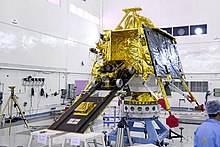
The mission's lander is called Vikram (Sanskrit: विक्रम, lit. 'Valour) Pronunciation (help·info) named after Vikram Sarabhai (1919–1971), who is widely regarded as the founder of the Indian space programme.The Vikram lander will detach from the orbiter and descend to a low lunar orbit of 30 km × 100 km (19 mi × 62 mi) using its 800 N (180 lbf) liquid main engines. It will then perform a comprehensive check of all its on-board systems before attempting a soft landing, deploy the rover, and perform scientific activities for approximately 14 days. The approximate combined mass of the lander and rover is 1,471 kg (3,243 lb).
The preliminary configuration study of the lander was completed in 2013 bythe Space Applications Centre (SAC) in Ahmedabad. The lander's propulsion system consists of eight 50 N (11 lbf) thrusters for attitude control and five 800 N (180 lbf) liquid main engines derived from ISRO's 440 N (99 lbf) Liquid Apogee Motor. Initially, the lander design employed four main liquid engines, but a centrally mounted engine was added to handle new requirements of having to orbit the Moon before landing. The additional engine is expected to mitigate upward draft of lunar dust during the soft landing.Vikram can safely land on slopes up to 12° Some associated technologies include a high resolution camera,Laser Altimeter (LASA), Lander Hazard Detection Avoidance Camera (LHDAC), Lander Position Detection Camera (LPDC),Lander Horizontal Velocity Camera (LHVC), an 800 N throttleable liquid main engine,attitude thrusters, Ka band radio altimeters (KaRA),Laser Inertial Reference & Accelerometer Package (LIRAP),and the software needed to run these components.Engineering models of the lander began undergoing ground and aerial tests in late October 2016, in Challakere in the Chitradurga district of Karnataka. ISRO created roughly 10 craters on the surface to help assess the ability of the lander's sensors to select a landing site.
- Dimensions: 2.54 × 2 × 1.2 m
- Gross lift-off mass: 1,471 kg (3,243 lb)
- Propellant mass: 845 kg (1,863 lb)
- Dry mass: 626 kg (1,380 lb)
- Power generation capability: 650 W
- Mission duration: ≤14 days (one lunar day)
 |
| Pragyan rover of the Chandrayaan-2 mission |
Pragyan rover
Main article: Pragyan (rover)
The mission's rover is called Pragyan (Sanskrit: प्रज्ञान, lit. 'WisdomPronunciation The rover's mass is about 27 kg (60 lb) and will operate on solar power.The rover will move on 6 wheels traversing 500 meters on the lunar surface at the rate of 1 cm per second, performing on-site chemical analysis and sending the data to the lander, which will relay it to the Mission Control on the Earth.For navigation, the rover uses:Stereoscopic camera-based 3D vision: two 1 megapixel, monochromatic NAVCAMs in front of the rover will provide the ground control team a 3D view of the surrounding terrain, and help in path-planning by generating a digital elevation model of the terrain. IIT Kanpur contributed to the development of the subsystems for light-based map generation and motion planning for the rover. Control and motor dynamics: the rover has a rocker-bogie suspension system and six wheels, each driven by independent brushless DC electric motors. Steering is accomplished by differential speed of the wheels or skid steering. The expected operating time of Pragyan rover is one lunar day or around 14 Earth days as its electronics are not expected to endure the frigid lunar night. However, its power system has a solar-powered sleep/wake-up cycle implemented, which could result in longer service time than planned.Two aft wheels of the rover have the ISRO logo and the State Emblem of India embossed on them to leave behind patterned tracks on the lunar surface,which is used to measure the exact distance travelled, also called visual odometr
- Dimensions: 0.9 × 0.75 × 0.85 m
- Power: 50 W
- Travel speed: 1 cm/sec.
- Mission duration: ≤14 days (one lunar day)
Payload


ISRO selected eight scientific instruments for the orbiter, four for the lander, and two for the rover.While it was initially reported that NASA and ESA would participate in the mission by providing some scientific instruments for the orbiter,ISRO in 2010 had clarified that due to weight restrictions it will not be carrying foreign payloads on this mission. However, in an update just a month before launch, an agreement between NASA and ISRO was signed to include a small laser retroreflector from NASA to the lander's payload to measure the distance between the satellites above and the microreflector on the lunar surface.


Thank You & Regards
Trupesh Kumbharana
+91 7016810725
Comments
Post a Comment